The commercial fitness landscape is undergoing a monumental paradigm shift. For decades, gym operators relied on static, laminated workout charts hung on concrete pillars, generic printed paper cards handed to new joiners, or one-size-fits-all workout splits copied from bodybuilding magazines. Today’s fitness consumer is digitally native, data-conscious, and demands hyper-personalized experiences tailored to their exact biometrics, schedule, and biomechanical limitations. Artificial Intelligence (AI) has emerged not as a futuristic novelty, but as an indispensable operational engine that bridges the gap between mass gym memberships and elite, customized personal training.
1. The Evolution of Workout Programming: From Static Cards to Dynamic Algorithms
In traditional gym management models, delivering bespoke workout programming was an expensive luxury reserved exclusively for the top 5% to 10% of members who could afford high-ticket 1-on-1 personal training packages. The remaining 90% of the gym floor—the general membership base—was left to navigate complex strength equipment, free weights, and cardio machines with minimal structured guidance.
This traditional dynamic created a massive operational failure point known in the fitness industry as the "90-Day Drop-Off Chasm." When novices enter a gym without a precise, data-backed roadmap, they encounter intimidation, lack of progressive overload, slow physical results, and eventual workout burnout. Within three months, over 60% of unguided members stop attending, leading directly to membership non-renewal.
AI-driven workout technology completely dismantles this operational bottleneck. By leveraging sophisticated machine-learning algorithms, modern fitness clubs can instantly generate individualized, scientifically periodized exercise regimens for every single member who walks through the turnstile. Rather than static templates, these algorithms adjust in real time based on user feedback, recovery metrics, and workout adherence, delivering the prestige of customized coaching at commercial scale.
"Personalization is no longer a premium upsell—it is the baseline expectation of the modern gym member. Facilities that fail to provide intelligent, interactive workout guidance are quickly categorized as commoditized iron rooms and face relentless price wars."
2. Core Mechanics: How AI Workout Builders Construct Elite Training Plans
Modern AI workout engines do not simply pull random exercises from a static database. High-grade fitness algorithms function as virtual exercise physiologists, processing multi-dimensional member data points to engineer safe, progressive, and highly effective workout routines. The core mechanics rely on four fundamental layers:
- Biometric Profiling & Body Composition Analysis: The AI ingests comprehensive baseline metrics including age, gender, biological weight, basal metabolic rate (BMR), visceral fat levels, skeletal muscle mass, and body fat percentage (frequently integrated directly with 3D body scanners or bioelectrical impedance scales like InBody).
- Biomechanical Screening & Injury Redirection: If a member flags pre-existing lower back lumbar pain, shoulder impingement, or patellar tendinitis during digital onboarding, the AI instantly modifies movement patterns. For example, it automatically substitutes conventional barbell deadlifts with trap-bar deadlifts from elevated blocks, or replaces overhead military presses with landmine presses to eliminate impingement angles.
- Autoregulation & Dynamic Progressive Overload: The algorithm tracks the member’s logged weight, repetitions completed, and Rate of Perceived Exertion (RPE) for every set. If a member hits 12 repetitions on an incline dumbbell press with an RPE of 6 (indicating high reserve energy), the system automatically prescribes an incremental 2.5 kg weight increase for the following session.
- Microcycle & Mesocycle Periodization: The engine structures training blocks into deliberate phases—hypertrophy, maximal strength, neuromuscular power, and active deload weeks—ensuring members avoid central nervous system (CNS) overtraining and continuous plateauing.
3. Empowering Trainers and Eliminating Administrative Burnout
A prevalent misconception in the fitness industry is that AI workout technology is designed to replace human personal trainers. In reality, forward-thinking gym owners use AI as a force multiplier that elevates trainer productivity, eliminates administrative burnout, and dramatically increases personal training (PT) conversion rates.
In a standard commercial gym, a full-time personal trainer spends between 8 to 12 hours every single week on tedious manual administrative tasks: drawing up workout spreadsheets, calculating training volumes, texting clients routine updates, and searching for exercise demonstration videos. This unpaid administrative burden drains trainer energy and caps the total number of paying clients a coach can effectively manage.
When an AI workout builder handles routine formulation and baseline volume calculations, trainers are liberated to focus on what humans do best:
- Hands-On Biomechanical Coaching: Providing real-time cueing on bar paths, pelvic alignment, and joint stability on the gym floor.
- Psychological Accountability & Motivation: Conducting deep motivational interviewing, empathy-driven habit coaching, and lifestyle accountability.
- High-Touch Client Servicing: Managing 25 to 30 active clients comfortably without sacrificing quality of care, directly increasing personal training gross margins for the facility.
4. Standardizing Coaching Quality Across Multi-Location Gym Chains
For gym owners operating multi-location chains or rapidly expanding franchises, maintaining uniform training quality across dozens of personal trainers is a persistent operational challenge. High trainer turnover frequently disrupts client routines, and varying levels of trainer certifications often lead to inconsistent client results.
Implementing an integrated AI workout platform establishes an immutable benchmark of exercise science across all club locations. Whether a member trains at your flagship downtown branch or a suburban satellite location, their historical workout logs, personal records (PRs), volume tolerances, and exercise progressions remain unified in the cloud. New trainers can instantly step in, review the client’s exact algorithmic history, and deliver seamless, world-class coaching without a single skipped session.
"Standardizing exercise programming through centralized AI software protects your gym brand. Your reputation for delivering physical results becomes an institutional asset owned by the gym, rather than walking out the door whenever a celebrity trainer switches facilities."
5. Gamification, Member Engagement, and Retention Economics
The financial health of any commercial fitness facility is governed by Member Lifetime Value (LTV) and average retention tenure. The primary driver of member churn is apathy—when members go to the gym, wander aimlessly between machines without a structured plan, fail to see measurable body composition changes, and subsequently abandon their fitness journey.
AI workout builders turn every gym session into an interactive, gamified journey. When members open their mobile workout portal, they are greeted with clear daily objectives, target rest timers, visual muscle-heatmaps illustrating which muscle fibers were recruited during the session, and instant notifications when they break personal strength records. This constant feedback loop triggers intrinsic motivation and transforms fitness from a chore into a rewarding daily habit.
Gyms that integrate intelligent mobile workout tracking experience an average 28% to 35% increase in 12-month member retention rates compared to traditional open-floor clubs. Furthermore, members who actively log their workouts in-app are 3.2 times more likely to purchase secondary services such as nutrition counseling, sports supplements, and advanced personal training packages.
6. How Fitplex Powers the AI-Driven Fitness Ecosystem
While standalone AI workout apps exist in consumer app stores, they operate completely disconnected from your gym’s physical facility, front desk, and biometric turnstiles. Fitplex Gym Management Software bridges this gap by embedding a state-of-the-art AI Workout Builder directly inside an enterprise-grade gym operating system.
Here is how Fitplex seamlessly integrates AI technology into your daily gym operations:
- Integrated AI Workout Builder: Fitplex features an intuitive, AI-assisted routine builder loaded with a rich library of 1,500+ high-definition 4K video demonstrations. Trainers or members can specify training goals (hypertrophy, fat loss, athletic conditioning), days per week, available equipment (barbells, cables, functional rigs), and injury flags to generate complete 12-week periodized plans in under 15 seconds.
- Direct Member App Synchronization: Workout programs sync directly to the branded Fitplex Member Mobile App. Members view exercise demo videos, log weights and sets, track rest timers between sets, and receive automated PR badges right on their smartphones.
- Biometric Check-In and Workout Activation: When a member enters your facility through Fitplex AI Face Recognition access gates, the system instantly logs their attendance and pushes an automated WhatsApp nudge or mobile notification: "Welcome back, Sarah! Today is Leg Day & Hypertrophy Focus. Open your Fitplex app to begin your warm-up."
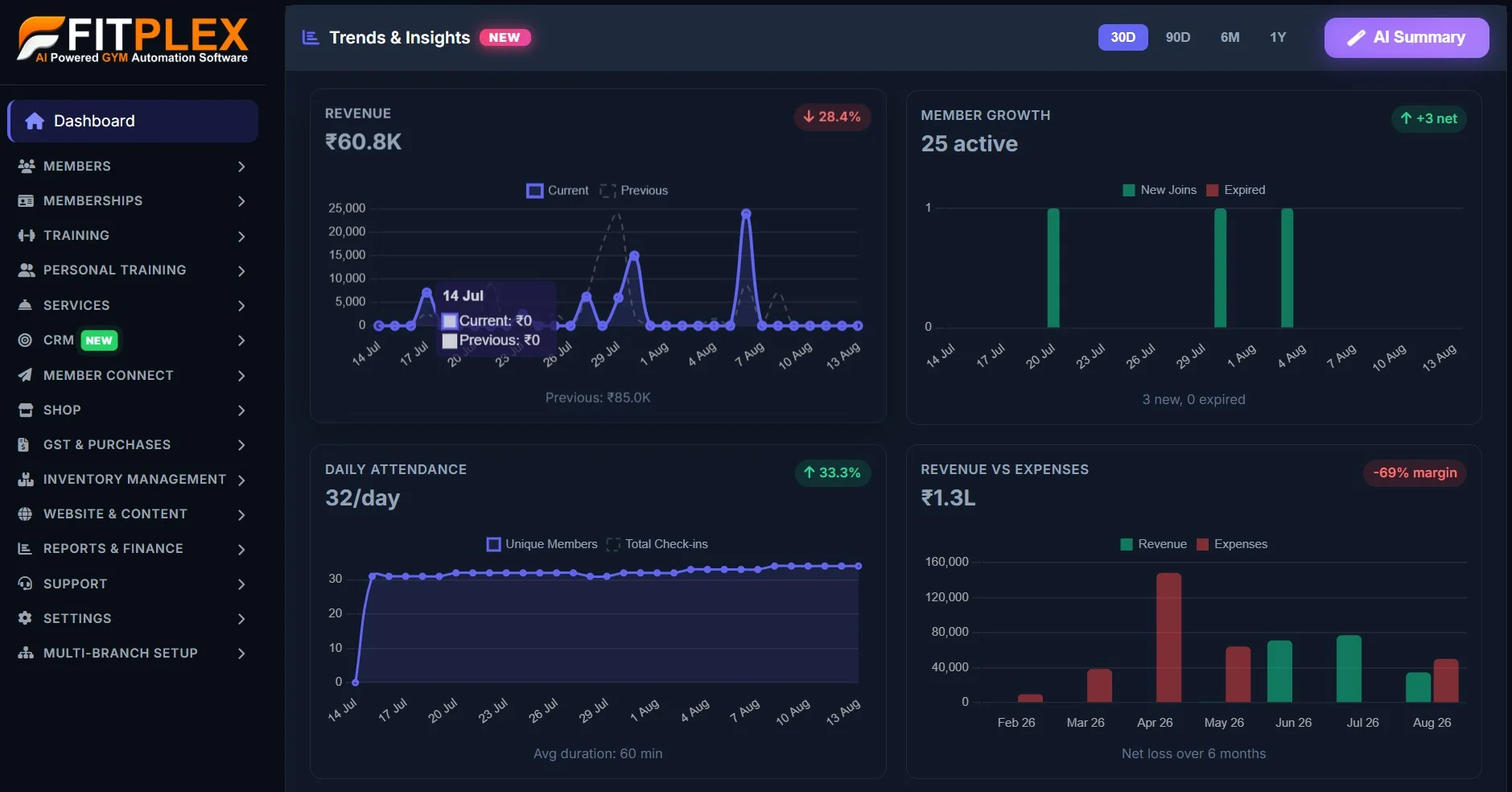
- Unified Assessment Tracking: Fitplex combines digital body composition logs, posture photos, and strength metrics into a centralized analytics dashboard. Trainers and club managers can evaluate client progress over time, generating professional branded transformation reports with one click.
- Automated Trainer Task Workflows: If a member fails to log their prescribed workout for 5 consecutive days, Fitplex automatically alerts their assigned personal trainer or floor manager, prompting a proactive check-in call or WhatsApp message to re-engage the member before they churn.
7. Practical Blueprint: Implementing AI Workouts in Your Gym
Transitioning your fitness facility into an AI-powered smart gym does not require expensive hardware overhauls. Gym operators can execute a seamless 4-step rollout:
- Digitize Onboarding at the Front Desk: Eliminate paper intake forms. When a member signs up, capture their initial health profile, fitness goals, and injury history directly inside the Fitplex onboarding wizard.
- Equip Floor Staff with the Trainer Dashboard: Train your personal trainers to use Fitplex’s AI Workout Builder during complimentary initial fitness assessments. Instead of giving a generic 20-minute tour, trainers present members with a customized, digitally mapped 30-day program.
- Promote App Adoption on the Floor: Place QR codes around strength and functional zones linking members directly to their Fitplex digital workout card, encouraging real-time set and rep logging.
- Track Business Intelligence & Retention ROI: Review Fitplex analytics monthly to identify your most popular exercises, floor utilization bottlenecks, member workout adherence rates, and trainer sales conversion metrics.
The future of fitness is intelligent, personalized, and data-driven. By integrating AI workout capabilities with robust facility management through Fitplex, gym operators can deliver unparalleled member experiences, empower their coaching staff, and build a highly profitable, future-proof fitness brand.